Cancer Immunologist

Training the Immune System to Recognize Cancer

Dr. Matt Halpert is a cancer immunologist whose research focuses on leveraging dendritic cells — specialized immune cells — to train the immune system to recognize and attack cancer. His work explores how these cells can be used to activate targeted immune responses and develop new approaches to cancer immunotherapy.

Explore the science

Dedicated to Advancing the Science of Cancer Immunotherapy

Matt Halpert earned his PhD from the University of Alabama at Birmingham and spent a decade conducting research, including at Baylor College of Medicine in Houston, where his work focused on emerging immunotherapy strategies.

During this time, Dr. Halpert authored numerous peer-reviewed publications and, alongside collaborators including Dr. William K. Decker and Dr. Vanaja Konduri, contributed to the development of novel approaches to cancer immunotherapy.

This collective work was instrumental in advancing the fundamental understanding of dendritic cell biology, the development of the 'double loaded' technology, and the application of this novel approach in the clinic for cancer patients. This is not just personalized immunotherapy, but rather introduces a truly one-of-a-kind physiological power in the fight against cancer.

Today, Dr. Halpert continues to study cancer immunology while working to translate this research into real-world treatments through Immunocine Cancer Center.


Dr. Matt Halpert
Founder & CEO
Immunocine Cancer Center
PhD — Microbiology & Immunology
University of Alabama at Birmingham
Former Researcher & Faculty
Baylor College of Medicine
Select Patents
Method for Producing Cytotoxic Effector Memory T Cells for T-Cell Treatment of Cancer
WO 2021092333A1  |  Inventors: Vanaja Konduri, William K. Decker, Matthew M. Halpert, Meenakshi G. Hegden, Nabil M. Ahmed, Sujith K. Joseph
Treatment of Mgmtp Unmethylated Glioblastoma
WO 2025212998A1  |  Inventors: William K. Decker, Vanaja Konduri, Matthew M. Halpert, Akshar Trivedi, Wei Liu, Madhuri Namekar
Potentiation of Durable Antitumor Immunity by Multifactorial Immune Modulation
EP 4493166A1  |  Inventors: William K. Decker, Matthew M. Halpert, Vanaja Konduri
Compositions Comprising and Methods of Using Dendritic Cell Exosomes
AU 2024267322A1  |  Inventors: Nalini Bisht, William K. Decker, Keenan Ernste, Matthew M. Halpert, Vanaja Konduri, Damilola Oyewolesaid
Dendritic Cell Immunotherapy
US 20220213440A1  |  Inventors: William K. Decker, Matthew M. Halpert
Select Publications
MHC Class I and II Peptide Homology Regulates the Cellular Immune Response
FASEB Journal  ·  2020  ·  Halpert MM, Konduri V, Liang D, et al.
Dendritic Cell-Secreted Cytotoxic T-Lymphocyte-Associated Protein-4 Regulates the T-Cell Response
Stem Cells and Development  ·  2016  ·  Halpert MM, Konduri V, Liang D, et al.
Chemo-Immunotherapy Mediates Durable Cure of Orthotopic Kras G12D/p53-/- Pancreatic Ductal Adenocarcinoma
OncoImmunology  ·  2016  ·  Konduri V, Li D, Halpert MM, et al.
Dendritic Cell Vaccination Plus Low-Dose Doxorubicin for Hemangiosarcoma
Cancer Gene Therapy  ·  2019  ·  Konduri V*, Halpert MM*, et al.
Multifactorial Immune Modulation Potentiates Durable Remission in Multiple Models of Aggressive Malignancy
FASEB Journal  ·  2024  ·  Halpert, M. M., Burns, B. A., et al.
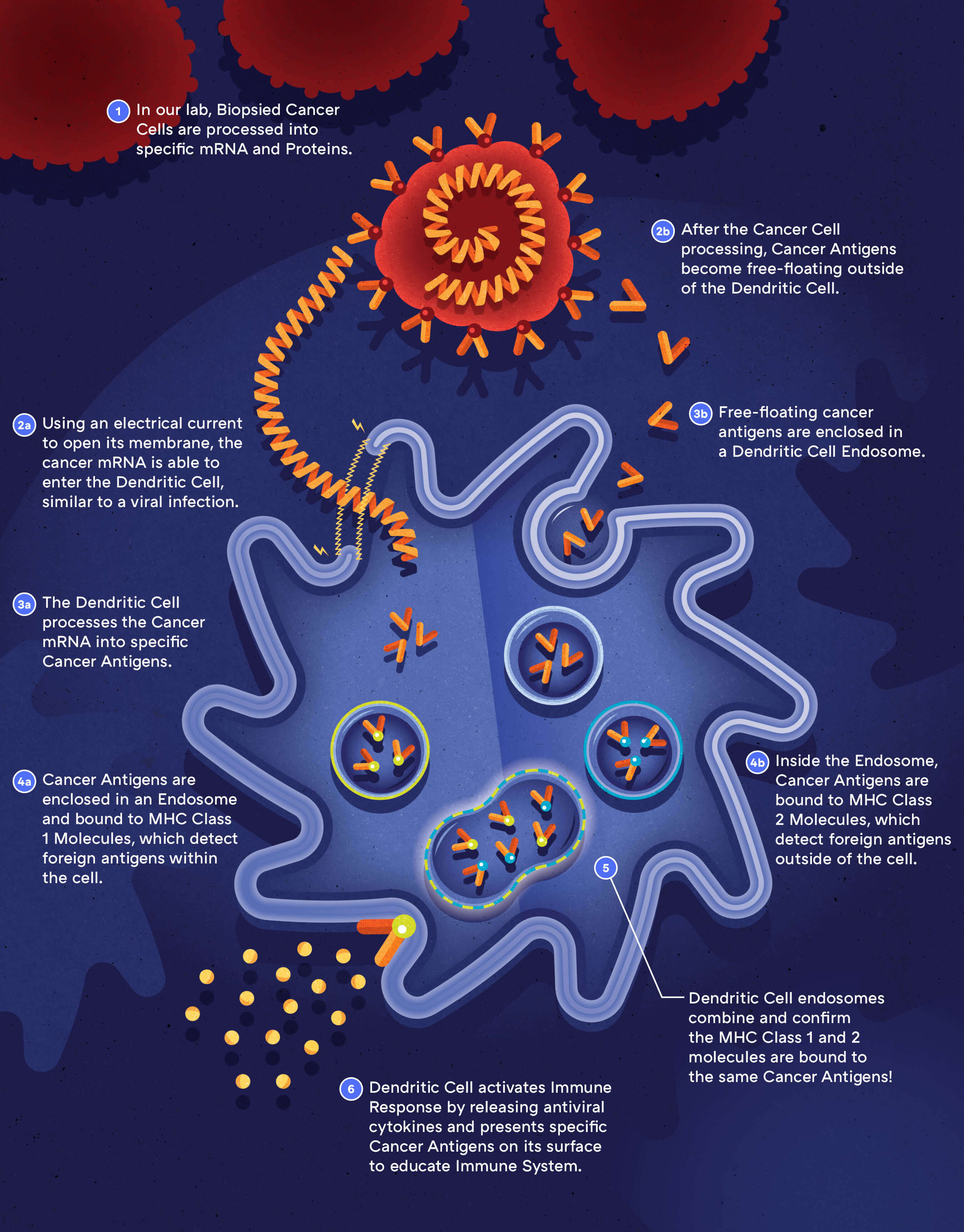
IDCT dendritic cell illustration — step one
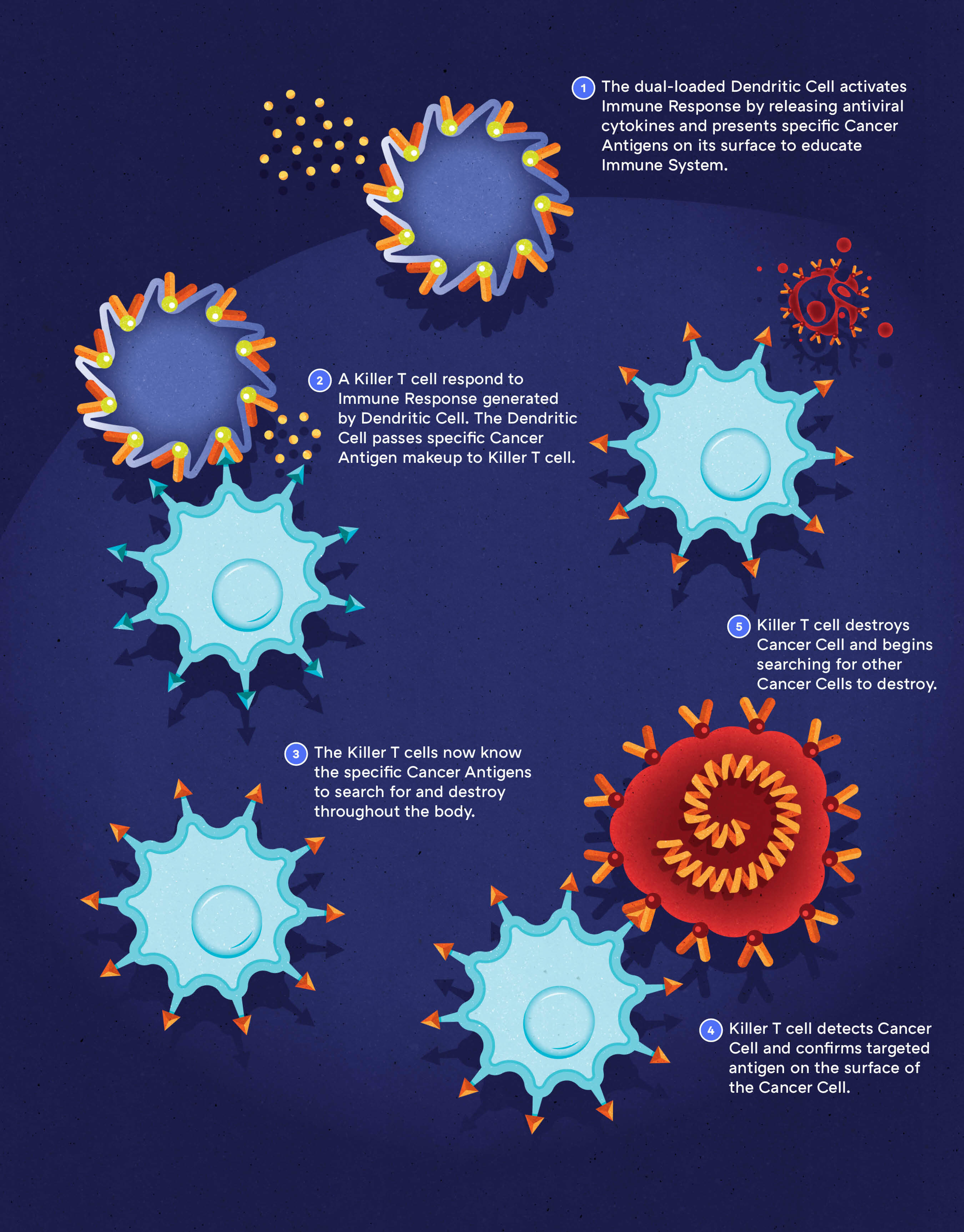
IDCT dendritic cell illustration — step two

The Problem: Cancer Evades the Immune System

Cancer can survive in the body by avoiding detection by the immune system. Dendritic cells play a central role in guiding immune responses by presenting target information and critical signals that help effector cells, such as T cells and Natural Killer cells, seek and eliminate threats.

However, while dendritic cells are essential to a complete immune response, they have historically underperformed in clinical cancer settings. Understanding how these cells interpret, process, and present tumor information remains a central focus of cancer immunology research.

The Breakthrough: Double-Loading Dendritic Cells

Building on this research, Dr. Halpert helped develop the Immunocine Dendritic Cell Treatment (IDCT protocol), a personalized immunotherapy designed to activate a patient's immune response using information from their tumor biology.

Through a double-loading approach, the dendritic cell's natural failsafe is removed as the cell is trained both inside-out and outside-in with patient-specific tumor signals. The trained cells are then reintroduced into the patient's lymphatic system to activate an immune response that seeks out and targets cancer.

The Future of Cancer Treatment, Today

Learn why Immunocine is a leading choice for patients seeking an advanced, scientifically-backed addition to standard of care.

Explaining this Science to the Public

Dr. Matt Halpert regularly shares insights on cancer immunology, emerging immunotherapies, and the science behind personalized cancer treatment.

Drawing on decades of work across academic research, education, and clinical practice, he speaks with audiences about how advances in immune science and tumor biology are reshaping the way we treat cancer.

Through podcasts, interviews, and public forums, Dr. Halpert translates complex scientific ideas into conversations that patients, clinicians, and the broader public can engage with.

Dr. Matt Halpert speaking at a public event
Speaking Topics
The Immune System and Cancer
How cancer evades immune detection and how modern immunotherapy approaches aim to change that.
Dendritic Cells and Personalized Immunotherapy
Understanding the role of dendritic cells and their potential in training the immune system to recognize cancer.
The Difficulties in Treating Cancer
Exploring the various ways cancer can fight back against standard of care options and immunotherapies.
The Future of Cancer Treatment
How advances in immunology and personalized medicine are reshaping the way we approach cancer therapy.